


DISCOVERING TMS THERAPY
TMS Therapy is a form of intensive neuromodulation.
Its formal name is Transcranial Magnetic Stimulation (TMS). TMS is a daily 20 to 50 minute brain stimulation procedure that is typically administered in an outpatient clinical setting.
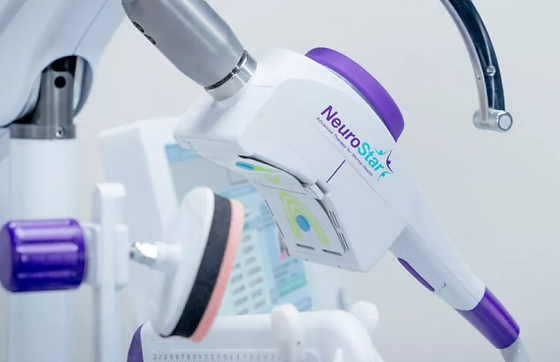
TMS Therapy is a non-pharmaceutical treatment option that uses highly focused magnetic pulses, similar in type & strength to those of an MRI. This advanced medical device delivers a targeted magnetic field to precisely stimulate and/or regulate key areas of the brain that control mood, pain, and focus. There is a wide range of TMS protocols available that address different conditions.
TMS THERAPY RESEARCH & DEVELOPMENT HISTORY
Because mental health diagnoses are typically associated with particular neurons of the brain either being overactive or underactive, medical researchers wanted to leverage the principles of physics to condition & optimize neurochemistry. They postulated that electromagnetism could induce action potentials in the brain.
A practical delivery method for this mechanism, which had been theorized for much of the 20th century, was realized by Dr. Tony Barker in 1985. This is when he & his team explored a creative application of electromagnetic pulsing. That is, they took a newly discovered technology system that was designed for stimulating the spine in the body, and they repurposed it to start treating depression in the brain.
The results were significant & lasting, which gave way to randomized trials that would help develop more standard protocols for a wider base of healthcare consumers in England (source: George MS, Taylor JJ, Short EB. The expanding evidence base for rTMS treatment of depression. Curr Opin Psychiatry. 2013 Jan;26(1):13-8. doi: 10.1097/YCO.0b013e32835ab46d. PMID: 23154644; PMCID: PMC4214363).
MODERN TECHNOLOGIES EVOLVING
Today, we have far more sophisticated brain imaging, and so clinicians have been able to use neuroimaging data to further identify associated behavioral patterns. This allows current procedures to be more targeted in terms of behavior & more precise with regard to coil placement.
It is now well accepted in academic & scientific research communities that the level of activity in certain parts of the brain can significantly influence associated behavior types as well as personality.
With regard to TMS, we know that the left prefrontal cortex of the brain is consistently underactive for people experiencing the symptoms of depression.
That is why/how providers know to stimulate the left side of the brain’s prefrontal cortex for cases of moderate to severe depression. For someone experiencing an anxiety-based condition, clinicians may try to regulate activity with slower magnetic pulsing & a different field polarity. In cases of OCD, a supervising physician will often prescribe activating pulses to the frontal lobe of the brain.
What’s great about this TMS procedure’s technical evolution is that there are now custom protocols & power levels available to help clinicians meet the personalized needs of every case. And this is important because each client adjusts to comfort differently during TMS treatment sessions.


CURRENT TMS LANDSCAPE
TMS Therapy has come a long way since its initial discovery by Dr. Tony Barker in 1985.
Leading TMS devices were actually approved by the FDA for U.S. markets in 2008, but then there was a bit of a transition phase so that clinicians were able to strengthen best practices outside of hospitals & research facilities.
There is now a proven track record for TMS Therapy as a preferred front-line care option.
And today we see TMS becoming accessible to a vast base of healthcare consumers who are seeking this proven technology all over the world.
We have clinical, policy, & manufacturing pioneers to thank for the widescale distribution of TMS that is currently available. Because traditionally, the standard options for mental health diagnoses have been outdated inpatient facilities, limited talk therapy, & prescription medications only.
GOING BEYOND TRADITIONAL STANDARDS
Many people do not find ‘traditional options’ to be viable or effective for a variety of reasons, which leads to a common mental health experience of ‘dead ends’ & ‘revolving doors’ in U.S. systems.
TMS can be a great higher-level alternative for anyone who has exhausted traditional resources or for those who are looking for something different.
For most Healing House clients, symptoms of depression & anxiety decrease significantly or remission is achieved after 4-6 weeks of intensive treatment with a NeuroStar TMS Therapy device.
Healing House is proud to contribute to best practices for TMS Therapy because it gives people the opportunity to truly ‘reboot’. Our team has witnessed incredible results for over 10 years in TMS practices with multiple Neurostar devices. And we like to frame TMS as the perfect ‘jump start’ for Healing House clientele to:
-
Awaken the mind/brain
-
Develop self-sufficiency
We believe that there is finally a treatment option delivering significant symptom relief or full remission without the dependencies and side effects that are associated with prescription drugs.
And when TMS is paired with the right combination of experienced providers plus complementary wellness modalities, it creates a grounded balance that reinforces results. We recommend this type of intensive program to experience sustainable lifestyle shifts that are completely transformative.


WHAT IS THE TMS PROCEDURE LIKE?
Specific treatment guidelines, originally established by Neuronetics, include the following:
-
TMS Therapy is available only under a Physician's supervision.
-
Treatment sessions are at a convenient in-office setting in a comfortable reclining chair.
-
Remain awake & coherent during sessions. No negative effect on alertness or cognition.
-
Each session is conducted for between 20-50 minutes, depending on the protocol.
-
Treatment is typically administered 5 days per week, for between 4-6+ weeks.
TMS Therapy programs are provided under the supervision of a licensed physician along with certified medical technicians. Upon completion of each treatment session, clients are able to resume their regular activities, including driving themselves home or moving into another treatment modality.
Most people receiving care continue with or subscribe to a variation of their existing medication regimen. Clients are guided by their administering physician while completing TMS Therapy at Healing House.
The administering physician is a Healing House provider who coordinates with existing clinicians, offers prescriptions and/or exit strategies, & makes wellness/lifestyle recommendations.
Healing House has a unique Care Philosophy when it comes to how we administer medical supervision for TMS services because our provider collective stays committed to a fully integrative approach.
Neurostar TMS Therapy is FDA Approved for Depression & OCD. Insurance Coverage Is Available.
BUT IT LOOKS LIKE IT HURTS!
TMS THERAPY IS COMPLETELY NON-INVASIVE.
Healing House technicians go through extensive training to ensure that we are treating to comfort.
Everyone’s level of sensitivity is different, and mild scalp discomfort is sometimes reported during the first week of treatment, but this typically subsides after the first few treatment sessions and can be alleviated with over-the-counter and/or natural pain remedies if necessary.
TMS is sometimes confused with Shock or ECT but is not even close to the same.


ARE THERE SIDE EFFECTS TO TMS THERAPY?
NONE TO MINIMAL & TEMPORARY.
Electromagnetic pulsing is not systemic, meaning it does not circulate throughout the body like prescription medications that are ingested. TMS Therapy is localized and is administered while clients remain conscious.
There are no serious side effects according to longstanding research as well as comprehensive clinical data.
There is no sedation or impact on alertness.
Clients are able to read, watch TV, listen to music, and/or talk with treatment coordinators comfortably during treatment.
WHO IS TMS THERAPY FOR?
WE USE TMS TO TREAT A VARIETY OF CONDITIONS
At The Healing House, we specialize in treating the following:
-
Medical Depression – Major Depressive Disorder (MDD)
-
Clinical Anxiety – General Anxiety Disorder (GAD)
-
Obsessive Thinking – Obsessive Compulsive Disorder (OCD)
-
Emotional Trauma – Post-Traumatic Stress Disorder (PTSD)
-
Addiction & Substance – Behavioral vs Chemical
Additional Off-Label TMS Therapy Protocols for: Cognitive Impairment, Autism, Memory Loss, Brain Inflammation, Tinnitus, Migraines, Anxiety Disorders, Chronic Pain and/or Fatigue
Healing House does not like to overemphasize diagnoses, but it is helpful to assess a baseline of behavior and use diagnostics as a tool to interface with the system for insurance coverage.


EVIDENCE-BASED OUTCOMES WITH TMS THERAPY
In a study of "real-world" outcomes (meaning actual NeuroStar care recipients), 83% of people who completed the full NeuroStar treatment cycle experienced a measurable decrease in the severity of their depression, and 62% of those completing treatment saw full remission - meaning their depression effectively "went away."
Neurostar TMS Therapy is FDA Approved for Depression & OCD. Insurance Coverage Is Available.
DOES INSURANCE COVER IT?
Over 300 million people have insurance plans that cover NeuroStar TMS Therapy, including Medicare and Tricare. Criteria & coverage details vary by insurance carrier, but our Healing House team is equipped to help determine policy benefits prior to starting treatment.
Healing House also offers non-covered arrangements plus in-house financing options. Connect with our team for more details.





ACADEMIC/RESEARCH ARTICLES, PRESS, & MEDIA:
-
Initial STAR*D Clinical Trials by NIMH (Updated 2009)
LEARN ABOUT A DIFFERENT FORM OF NEUROMODULATION FOR PERFORMANCE.
Neuronetics Disclaimer:
Adult Indications for Use The NeuroStar Advanced Therapy System is indicated for the treatment of depressive episodes and for decreasing anxiety symptoms for those who may exhibit comorbid anxiety symptoms in adult patients suffering from Major Depressive Disorder (MDD) and who failed to achieve satisfactory improvement from previous antidepressant medication treatment in the current episode. The NeuroStar Advanced Therapy System is intended to be used as an adjunct for the treatment of adult patients suffering from Obsessive Compulsive Disorder (OCD).
Adolescent Indications for Use NeuroStar Advanced Therapy is indicated as an adjunct for the treatment of Major Depressive Disorder (MDD) in adolescents (15-21).
Important Safety Information NeuroStar Advanced Therapy is only available by prescription. A doctor can help decide if NeuroStar Advanced Therapy is right for you. Patients’ results may vary. The most common side effect is pain or discomfort at or near the treatment site. These events are transient; they occur during the TMS treatment course and do not occur for most patients after the first week of treatment. There is a rare risk of seizure associated with the use of TMS therapy (<0.1% per patient).
Visit neurostar.com for full safety and prescribing information.